Studying how electronic devices perform in extreme environments is crucial for space applications. The IRLabs Rigel Dewar system offers a cutting-edge solution for characterizing total ionizing dose (TID) effects at cryogenic temperatures. With a modular design that accommodates various device packages and integration with a Keysight B1500A parameter analyzer, this system enables precise DC and noise characterization from 300K to 77K. Initial results highlight its effectiveness in detecting radiation-induced degradation trends, making it a valuable tool for advanced dosimetry and transistor analysis in space-related research.
IRLabs recently completed a project with Arizona State University’s Fulton Schools of Engineering to test the Rigel dewar system. Two critical design principles for the system were portability and versatility.
INTRODUCTION
As the space industry continues to grow, companies are investing heavily in technology that can withstand the harsh radiation environment that exists in space. Devices must be specifically designed to mitigate radiation-induced effects like total ionizing dose (TID) effects, single event effects (SEE), and displacement damage. These effects can damage electronics in space and other environments, leading to degraded performance, data corruption, or even functional destruction.

Radiation is not the only challenge faced by space-bound electronics. Many applications, particularly those in deep- space exploration, require electronics to operate reliably at cryogenic temperatures. For example, temperatures as low as 40K may be encountered in missions to the outer planets or in certain spacecraft like the James Webb Telescope. These combined environmental stressors—high radiation levels and extremely low temperatures—pose significant risks to device functionality and reliability. Without robust testing methods that replicate these conditions, it becomes impossible to fully understand the critical performance metrics of radiation-tolerant devices, such as their electrical stability, degradation mechanisms, and overall reliability.
In order to ensure proper performance of electronic components in extreme temperature and radiation environments, specialized device characterization systems must be built to simulate these harsh environments, terrestrially. However, most methods fail to emulate the combination of cryogenic temperatures and radiation environments thus limiting their ability to fully replicate the operational conditions faced by these parts in space. It is important to have testing environments that mimic these extreme conditions so critical performance metrics can be quantified.
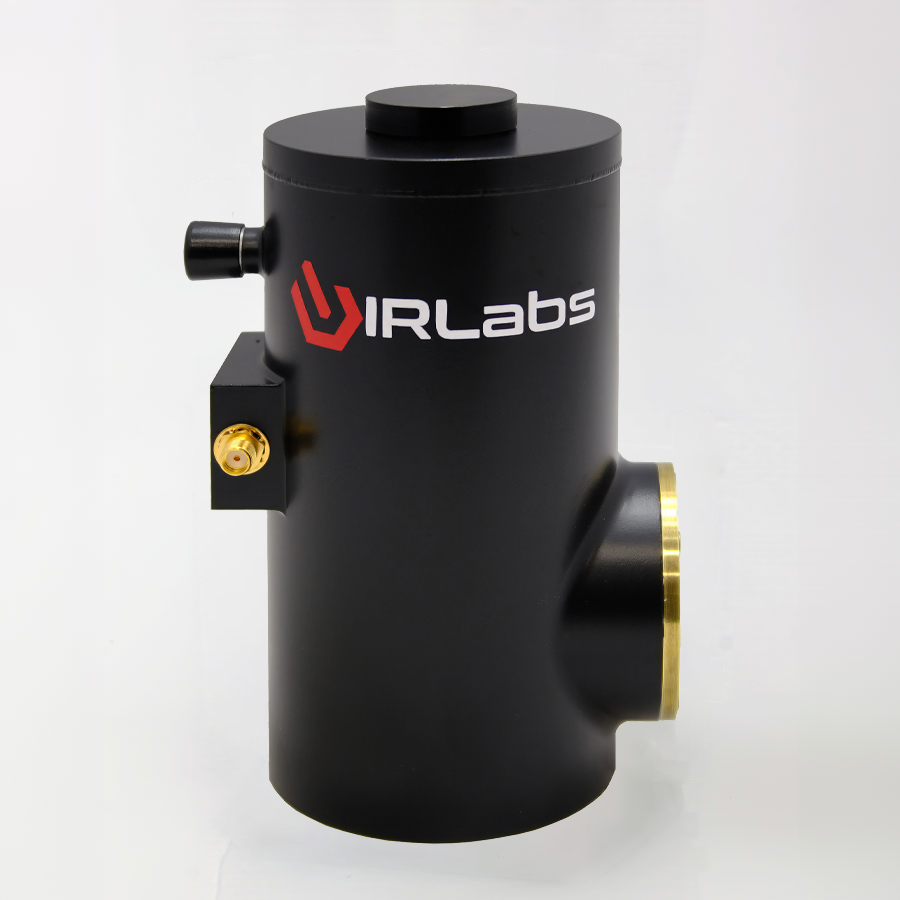
To address this need, IRLabs has developed the Rigel Dewar system, shown in Fig. 1. This system makes it possible to do irradiation at cryogenic temperatures with a focus on modularity and versatility. This system utilizes custom printed circuit boards (PCBs) to interface with the device within the dewar allowing for in-situ characterization at cryogenic temperatures. By combining cryogenic cooling with customizable testing capabilities, the Rigel dewar system offers a unique solution to the challenges of space electronics testing. The authors would like to acknowledge IRLabs for their contribution in designing and providing the physical dewar, which forms the backbone of this system. Thanks to this collaboration and the system’s adaptability, a myriad of device packages can be accommodated and designed around, ensuring broad compatibility and use.