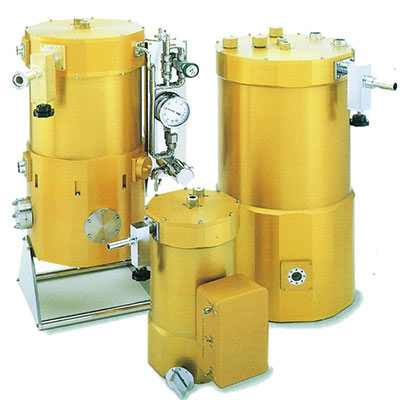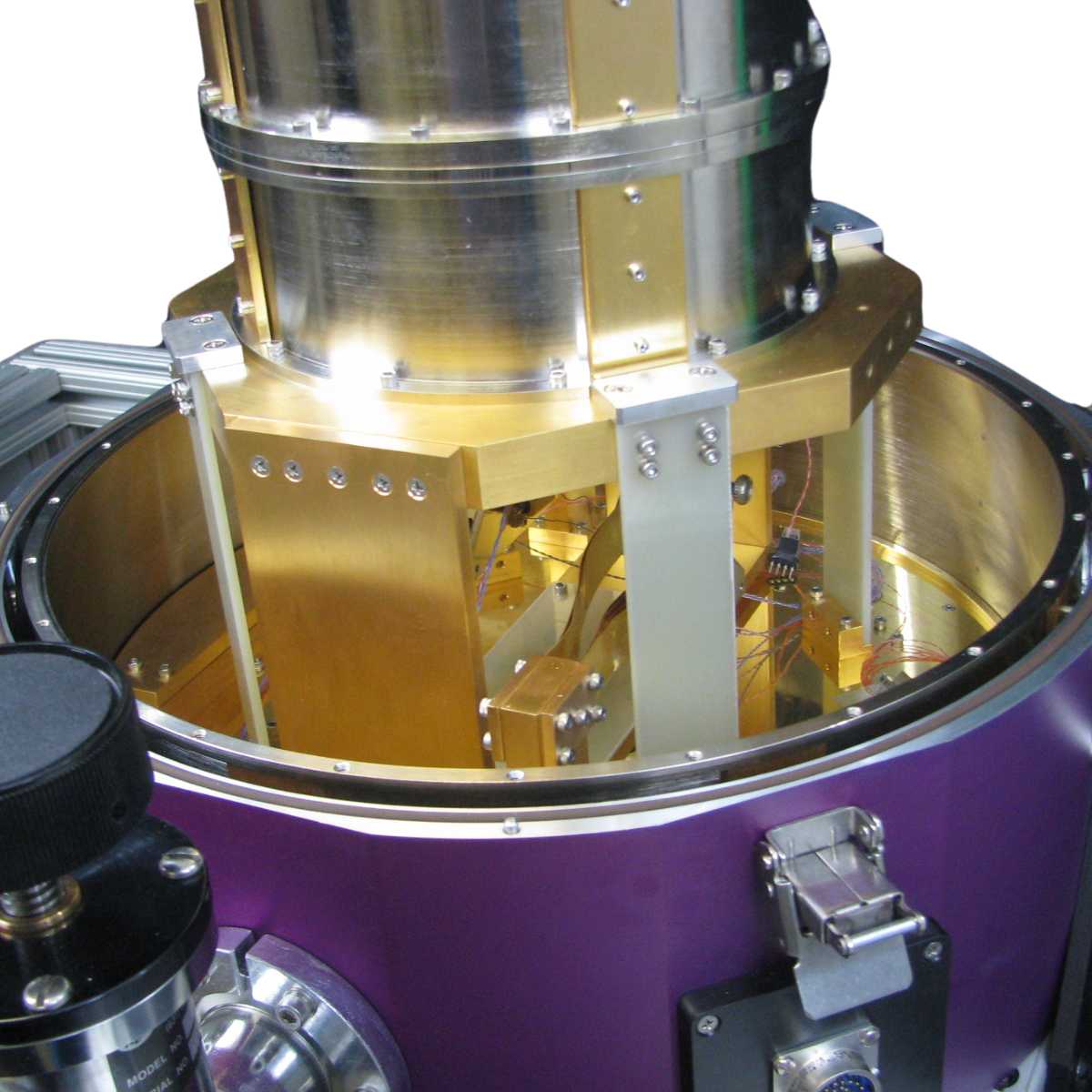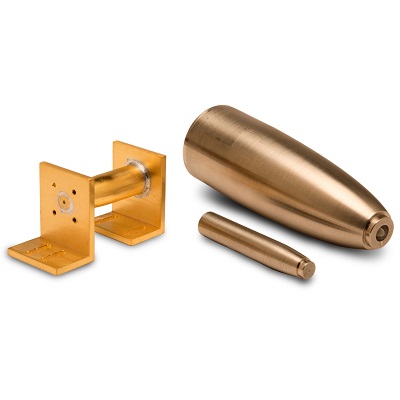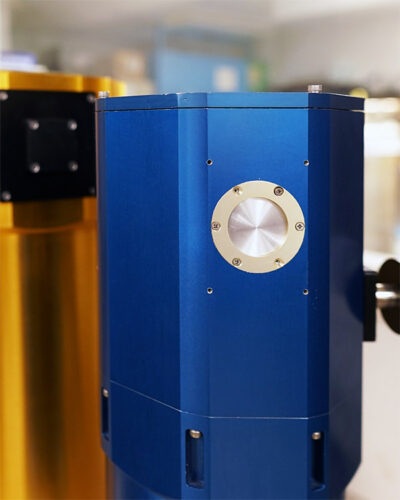
Building upon our legacy in astronomical research, our cryostats represent over four decades of innovation in observatory-grade cooling systems. Originally developed for university telescopes, our cryostat technology has evolved to become the standard for leading astronomical observatories worldwide.
Our cryostats are specifically engineered to meet the demanding requirements of modern astronomical instruments, including:
- Infrared Detector Cooling: Achieving ultra-low temperatures crucial for reducing thermal noise in sensitive IR detectors and maintaining optimal signal-to-noise ratios
- Multi-Stage Cooling Systems: Incorporating advanced staged cooling design to reach temperatures below 4K, essential for operating superconducting devices and bolometer arrays
- Long-Duration Operation: Engineered for extended observation periods with minimal maintenance, featuring sophisticated thermal management and automated LN2/LHe filling systems
- Vibration Isolation: Implementing proprietary dampening technology to eliminate mechanical interference with astronomical measurements
From the world’s largest ground-based telescopes to space-based observatories, our cryostats have enabled groundbreaking discoveries in:
- Deep-field infrared imaging
- Spectroscopic analysis
- Submillimeter astronomy
- Quantum sensor applications
Our continued collaboration with leading research institutions ensures our cryostat designs remain at the forefront of astronomical technology, incorporating the latest advances in cryogenic engineering and detector cooling requirements.
Trust the same precision-engineered cryostats that power discoveries at facilities like:
- Keck Observatory
- Gemini Telescopes
- European Southern Observatory
- Major national laboratories
Each astronomical cryostat is custom-designed to meet specific observational requirements while maintaining the reliability and performance that has made us a trusted partner in the astronomical community for generations.