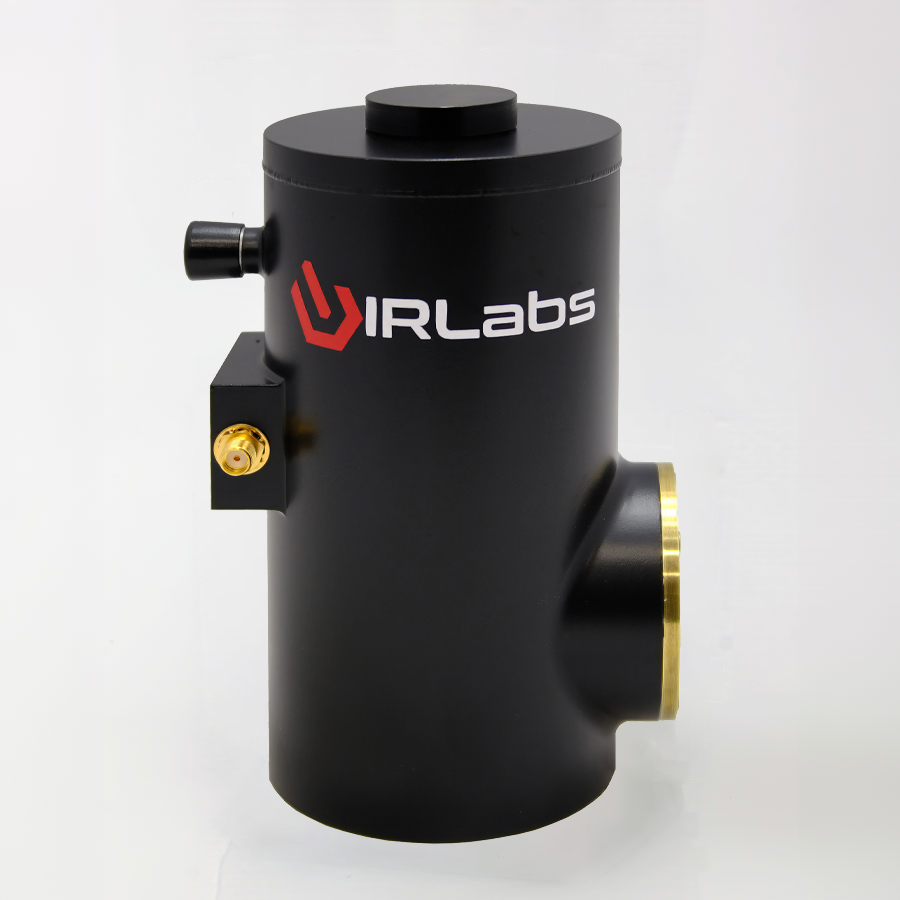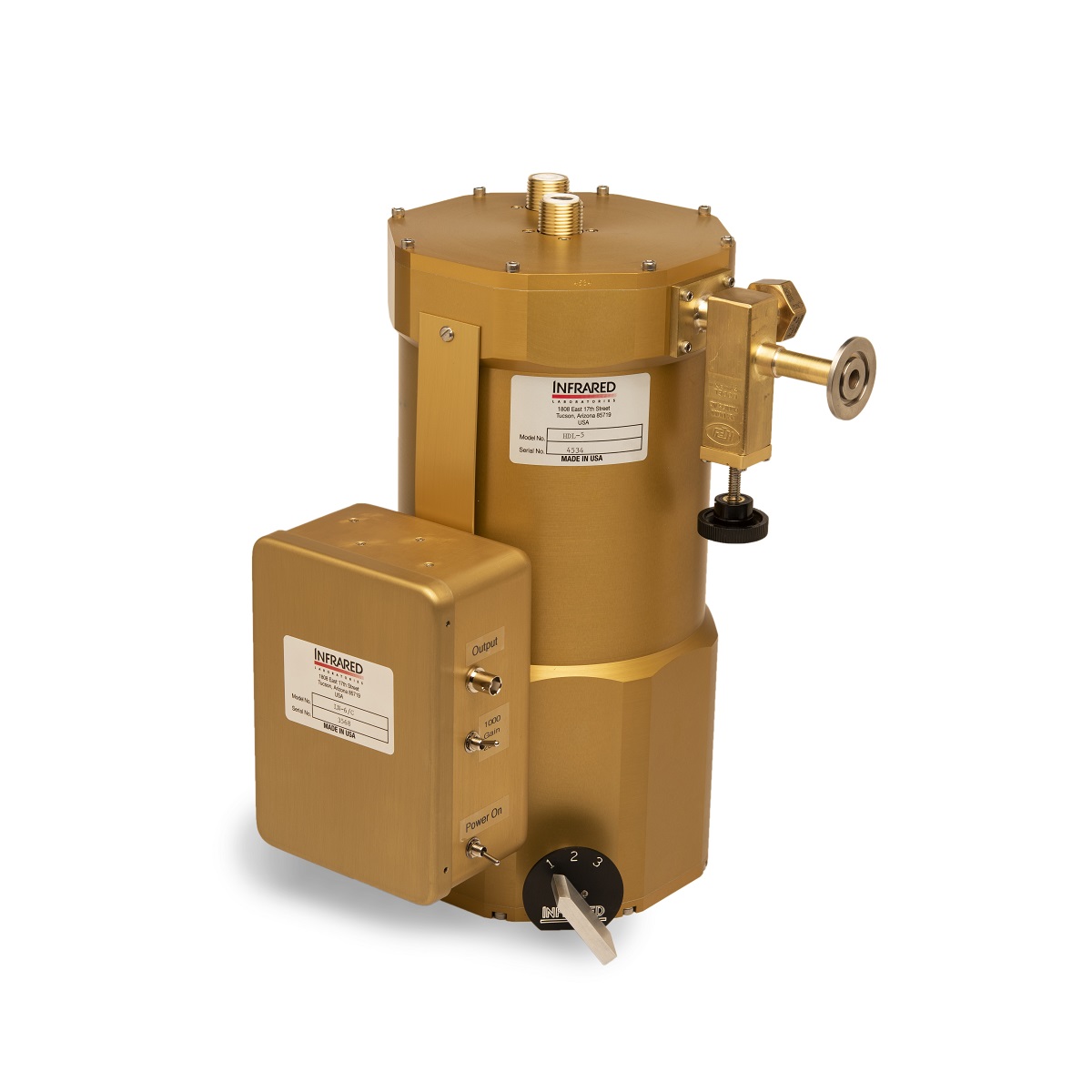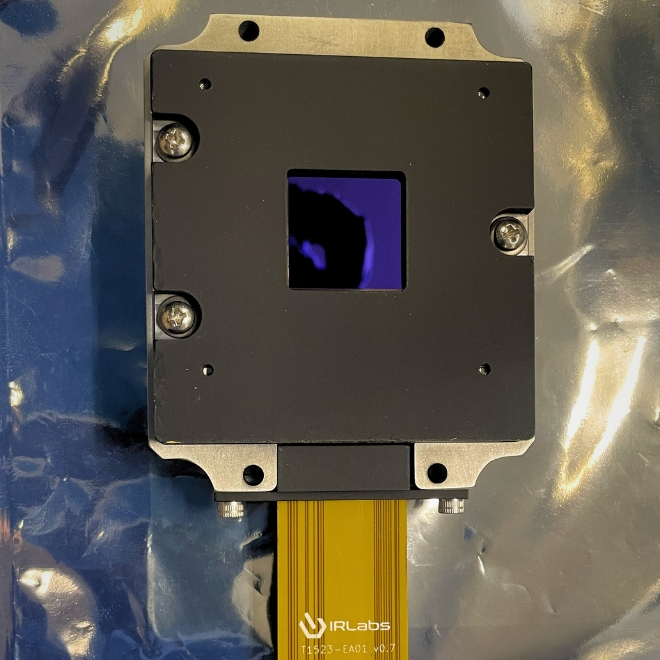
Infrared focal plane arrays (FPAs) are critical to advancing our view of the universe, especially in challenging environments where visible light falls short. In this post, IRLabs unpacks the role of IR FPAs in scientific imaging applications, from astronomical observatories like James Webb Space Telescope to advanced laboratory test systems. Learn how these detectors are designed, where they’re used, and what’s next in their evolution.
What Is a Focal Plane Array?
A focal plane array (FPA) is a two‑dimensional grid of photodetectors placed at the image plane of an optical system. FPAs are high-sensitivity image sensors that detect infrared radiation for diverse applications, from scientific research to astronomy, and can also support thermal imaging. For scientific labs and astronomy facilities, FPAs are critical for measuring temperature variations, mapping celestial infrared sources, and capturing high‑sensitivity imaging data.
FPAs convert incoming photons—especially in the infrared range—into electrical signals. Unlike conventional CCD or CMOS visible‑light sensors, infrared FPAs are tailored to detect mid‑wave IR (MWIR) or long‑wave IR (LWIR) photons using specialized materials like InSb or HgCdTe. They are a form of advanced image sensor optimized for infrared radiation rather than visible light.
Types of Focal Plane Arrays
- Cooled vs Uncooled FPAs
- Cooled FPAs use cryogenic cooling to minimize thermal noise, offering maximum sensitivity and lower noise equivalent temperature difference, essential in astronomy and spectroscopy.
- Uncooled FPAs (such as microbolometer arrays) operate at ambient temperature, are more cost‑effective, and are widely used in lab thermal imaging, industrial R&D, and environmental monitoring.
- Staring vs Scanning FPAs
- Staring arrays are fixed 2D arrays capturing full frames simultaneously—common in infrared and thermal imaging.
- Scanning arrays are linear detectors requiring mechanical or optical scanning to build up an image.
- Sensor Materials
- InSb, HgCdTe (MCT), PbSe, MOS microbolometers and emerging Type‑II superlattice (T2SL) sensors power modern FPAs. Recent work on MCT p‑on‑n technology by Leti and Lynred enhances performance and manufacturability (Journal of Electronic Materials).
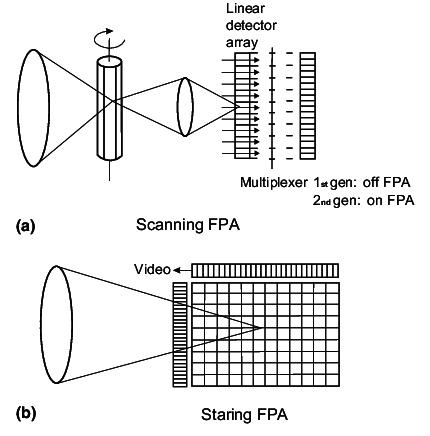
Scanning and staring focal plane array systems. Reproduced under CC BY-NC-ND 3.0 license from A. Rogalski, “History of infrared detectors,” Opto-Electronics Review, vol. 20, no. 3, pp. 279-308, 2012. DOI: 10.2478/s11772-012-0037-7.
How Focal Plane Arrays Work
Incoming photons are focused by the optics onto the FPA grid. Each pixel captures these photons, producing a charge or voltage that the readout integrated circuit (ROIC) amplifies for further processing. In cooled FPAs, cryogenic systems reduce thermal noise drastically. Integration time, pixel pitch, and ROIC architecture directly influence spatial resolution, quantum efficiency, frame rate, and overall signal‑to‑noise ratio.
Applications in Scientific and Astronomy Labs
- Astronomy: FPAs are essential for telescopes detecting faint IR sources like exoplanets and nebulas. Infrared observatories like the James Webb Space Telescope use sophisticated focal plane arrays to detect faint heat signatures from distant galaxies, enabling unprecedented insight into the early universe. The Vera Rubin Observatory’s LSST camera—featuring a 3,200 megapixel focal plane—is the largest digital camera ever built and will transform surveys of dark matter and dark energy.
- Spectroscopy & Hyperspectral Imaging: Lab instruments rely on FPAs to capture multiple infrared bands across narrow or wide spectral ranges for materials analysis or chemical identification.
- Scientific Research: FPAs support thermal imaging studies of material behavior, chemical kinetics, and biological processes.
- Remote Sensing & Environmental Monitoring: Airborne or satellite systems use infrared FPAs for vegetation monitoring, atmospheric temperature mapping, and land‑use studies.

JWST’s NIRCam (Near Infrared Camera) uses 10 mercury-cadmium-telluride (HgCdTe) FPAs as its detectors.
Key Performance Metrics
Projects and lab buyers evaluate FPAs based on:
- Resolution: Total pixel count (e.g., thousands to millions) and pixel size help dictate the system’s spatial detail.
- Noise Equivalent Temperature Difference (NETD): Lower NETD means better ability to discriminate small IR temperature differences.
- Quantum Efficiency: Percent of photons converted to electric signal.
- Frame Rate / Integration Time: Higher frame rate supports dynamic phenomena or fast scanning.
- Signal‑to‑Noise Ratio (SNR): Essential for faint signal detection in astronomy or spectroscopy.
Recent Innovations in FPA Technology
- Advances in MCT p‑on‑n technology improve yield, sensitivity and reduce cost for cooled IRFPAs (Science Journal Research).
- Type‑II superlattice sensors and AI‑driven signal processing enable higher pixel count with better calibration. The trend toward SWaP‑C (size, weight, power, cost) reduction is expanding FPA use in compact lab setups and CubeSat platforms.
- Detector systematics—persistence, hot pixels, snowballs—are better characterized and mitigated in instruments like the JWST IR focal plane, improving long‑term stability (SLAC Indico).
Considerations for Lab Use & Procurement
- Define wavelength range and sensitivity needs: cooled vs uncooled, SWIR/MWIR/LWIR depending on your science goals.
- Pixel count and frame rate: higher pixel resolution or faster frame rates increase data volume and cost.
- Ensure compatibility with existing optics, cryogenic systems, and data acquisition infrastructure.
- Plan for calibration, maintenance, and long‑term drift monitoring, particularly for cooled FPAs.
- Work with vendors specializing in lab and astronomy FPAs; consider support for integration, calibration and future upgrades.
Market Size & Growth (2025 and Beyond)
- The global focal plane array market was estimated at approximately USD 3 billion in 2024, growing at a CAGR of 7‑8 percent through 2029.
- The uncooled FPA infrared detector segment specifically was valued at USD 1.08 billion in 2023 and is projected to reach USD 3.51 billion by 2030, with a rapid CAGR of 15.1 percent from 2024 to 2030.
- Some sources estimate the uncooled IR FPA market at USD 2.5 billion in 2025, growing at roughly 10 percent annually to 2033.
These figures reflect rising adoption across civilian sectors such as industrial, automotive, security and aerospace, as well as continued investment in science and astronomy.
Foundational Image Sensors
Focal plane arrays are foundational image sensors for scientific labs and astronomy instrumentation. They convert infrared radiation into precise, high‑resolution images that support breakthroughs in research, from thermal processes to mapping the cosmos. With the focal plane array market reaching nearly USD 3 billion, and uncooled FPA demand expanding rapidly, labs should evaluate the right FPA type, material and performance profile to meet their technical requirements—then consult instrumentation specialists or vendors to integrate FPAs into cutting‑edge research systems.
Ready to begin your next project? Connect with the team at IRLabs to get started.