
Demanding bolometer specifications are not a problem for us. We produce ultra low noise and cost-effective bolometers across a wide spectral range. Our bolometer systems each offer advantages to best meet your spectral band, frequency response, noise, budget, and cryogenic or cryogen-free cooling requirements. We have decades of experience customizing configurations to meet your specific application requirements including longer hold times, increased work height, dual detectors, filter positions, coupling options, and more.
Bolometer Systems Table
| Bolometers | Spectral Response (µm) | Operating Temp (K) | Electrical Sensitivity (S[V/W] | Noise Equivalent Power [W/Hz(1/2)] | Noise Vn[nV/Hz(1/2)] | Frequency Response (Optimum Chopping Frequency) | Liquid Cryogen Cooling | Cryogen-free Cooling |
|---|---|---|---|---|---|---|---|---|
| General Purpose 4.2 K Bolometer System | 15 – 2000 | operation to 4.2 | ~ 2.4 X 10⁵ | ~ 2.5 X 10⁻¹³ | ≤ 80 at 80Hz | < 500 Hz | ||
| Hi Res 4.2K Bolometer System | 15 – 500 | operation to 4.2 | ~ 6.1 X 10⁵ | ~ 6.5 X 10⁻¹⁴ | ≤ 40 at 80Hz | < 200 Hz | ||
| Standard 1.6 K Bolometer System | 15 – 2000 | 1.6 | ~ 7.5 X 10⁵ | ~ 4.6 X 10⁻¹⁴ | ≤ 40 at 80Hz | > 1 KHz | ||
| Far-IR 1.6 K Bolometer System | 300 – 5000 | 1.6 | ~ 1.0 X 10⁷ | ~ 3.6 X 10⁻¹⁵ | ≤ 50 at 80Hz | < 300 Hz | ||
InSb Hot e-Bolometer | 0.3mm – 5mm | 4.2 | > 4.0 X 10³ | < 8 x 10-13 | < 4.0 at 200Hz | < 600 kHz |
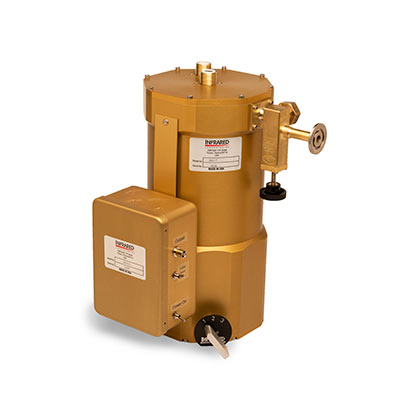
Cryogenic Bolometers
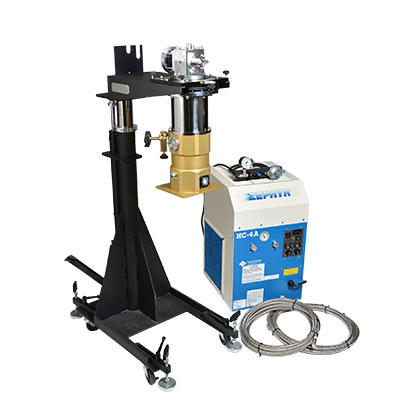
Cryogen-free Bolometers
What is a bolometer?
Bolometers measure changes in incident infrared radiation which often corresponds to changing temperatures. This allows the bolometer to excite and relax, thus a measurement of the change in resistance is made that corresponds to the energy of the incident radiation. The speed at which the bolometer reacts to this temperature change is dependent upon several factors that can be altered, if desired, at the time the system is ordered.
What is Bolometry?
Bolometry involves detecting radiation by measuring the temperature change in a sensitive element, typically a bolometer. Because temperature variations can cause objects to emit differing amounts of radiation that may not directly correspond to the target signal, the incoming radiation is modulated to isolate what is being measured. This modulation causes the sensing element to cycle between excitation and relaxation, allowing its change in electrical resistance to be recorded as a measure of incident energy. The response speed of the detector to these temperature changes depends on several design factors, which can be adjusted when the system is specified.
Bolometry applications include astronomical observations, plasma diagnostics, materials research, and infrared spectroscopy. Our bolometry systems support precision measurements in laboratories and where traditional detection methods fall short.
Cooled using liquid cryogens or cryo-free mechanical refrigeration.
Bolometers are cooled to cryogenic temperatures using pour-filled liquid cryogen dewars or cryogen-free mechanical refrigeration. Liquid cryogen coolers are compact with no moving parts, easy to use, have a lower initial cost, and recommended for simple, reliable operation. Refrigerated systems are larger, more complex, and have a higher initial cost but eliminate the expense of refilling cryogens. Cryo-free cooling is recommended for cost-effective, continuous unattended cold operation: